
Production planning software
Every factory has a plan. The question is whether it lives in a system everyone can see, or in a whiteboard and one person's head.
Production planning software sold as a package tends to assume a factory that makes the same things in the same order with the same machines. Real factories have a machine that only two people can set, a customer who always changes the order, and a job that has to be done before lunch because of the way the ovens work.
Packages handle that with workarounds. Eventually the workarounds become a spreadsheet that sits alongside the expensive system, and you are back where you started.
What we do instead
We build the constraint into the system. If a job cannot run on that machine after a particular product without a clean down, the plan knows. If a setter is off, capacity drops. The schedule stays true because it understands the same rules the planner does.
Start with the plan, not the whole factory
We usually start with scheduling and visibility, because that is where the fastest return is. Shop floor capture and job costing follow once the plan is trusted. You get value in stages instead of waiting a year for a system to land in one piece.
What is included
What you get
Scheduling
Jobs planned against machines, people and shifts, with the constraints your factory actually has.
Works orders
Raised from sales orders or forecast, with the materials and operations attached.
Materials
What the job needs, what is in stock, and what has to be ordered, before the job hits the floor.
Shop floor data capture
Start, pause and complete recorded where the work happens, so the plan reflects reality within minutes rather than days.
Capacity view
What is committed and what is free, so you can answer a delivery question without a meeting.
Job costing
Actual time and materials against the estimate, on the job, not at the end of the quarter.
Traceability
Batch and lot tracking where your sector requires it.
Reporting
On time delivery, machine utilisation, scrap and whatever your customers ask you to prove.
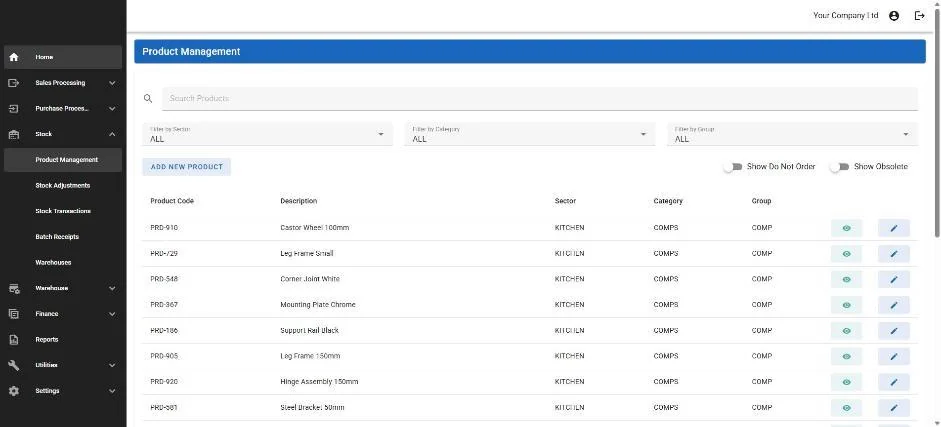
- Every level in one placeTotal, quarantine, sales, picked, tray and QA quantities against the one product.
- Packing data where it is usedInner quantity, outer pack and packs per pallet, so despatch is not a separate guess.
- Built around the productSales orders, purchase orders, stock transactions and barcodes all hang off the same record.
How we work
What working with us looks like
- 1
Spend time on the floor
We watch a shift. The exceptions and the workarounds are where the real requirements are.
- 2
Scope it
A written scope, a fixed price and an honest view of what will not be worth automating.
- 3
Build in stages
Usually scheduling first, then data capture, then costing, so value arrives before the whole thing is finished.
- 4
Roll out with training
On site, with your own jobs, with the people who will use it.
No obligation
Come and look at our factory
That is usually the first thing clients say, and it is the right instinct. We will come and watch a shift before we quote.
Case study
Written in 1999. Still running today.
We shipped order processing software to a company in the Odlings Group on the 23rd of July 1999, on seven floppy disks. We still have the disks. Some of what is on them is still running in production, twenty seven years later.
Your understanding of the technology available coupled with detailed discussions on the desired outcome has produced a system with capabilities I did not imagine a business our size would be able to achieve. We have gone from a paper system, to a fully traceable production process. This has enabled our office staff to be able to communicate far more confidently with our customers.
Common questions
We are not a big manufacturer. Is this overkill?
Full ERP usually is. A focused system that does scheduling and shop floor capture for your specific process usually is not, and it costs a fraction of the licence fees. That is the gap we build into.
Will the shop floor actually use it?
Only if it is faster than what they do now. That is a design constraint, not an afterthought. Screens for the floor need to be big, simple and quick, and we test them with the people who will use them before go live.
Can it talk to our existing systems?
Usually, yes. Most production planning projects we do connect to a sales order system, a stock system or an accounts package.
What if our process changes?
It will. That is the advantage of a bespoke system over a package. We change it, and it is supported by the same team that looks after your IT.
Get in touch
Tell us what is not working
Send us a line about your setup and we will come back with what we would actually do about it. No sales pitch, no obligation.
Or call 01482 586 550 or email info@selectgroup.co.uk.
This form is provided by Growably. See our privacy policy.
Want a straight answer about your IT?
Tell us what is not working. We will tell you what we would do about it, with no sales pitch and no obligation.